 Add to Chrome
 Add to Firefox
 Add to Edge
Learning to Label: A Reinforced Self-Evolving Framework for Semi-supervised Referring Expression Segmentation
May 27, 2026
Semi-supervised referring expression segmentation (SS-RES) aims to achieve precise pixel-level language grounding under limited annotation, yet suffers from limited supervision and unreliable pseudo-labels when exploiting unlabeled image-text pairs. In this work, we propose Learning to Label, a reinforced self-evolving framework (L2L) that casts pseudo-label construction as a learnable decision-making process. To build foundational understanding, we leverage a multimodal large language model to extract semantic-spatial priors, which are instantiated as initial soft segmentation proposals and elevated, together with textual cues, into learnable guidance signals that condition a hierarchical segmentation network. To ensure stable learning, reinforced pseudo-label selection is formulated as an exploratory decision process that adaptively rewards high-utility pixel-level supervision based on multimodal priors and model predictions. This reinforced self-evolving loop enables joint optimization of the segmentation model and pseudo-labels, progressively enhancing label reliability under sparse supervision. Extensive experiments on RefCOCO, RefCOCO+, and RefCOCOg demonstrate improvements over existing methods, validating its effectiveness and generalization.

Claw AI Lab: An Autonomous Multi-Agent Research Team
May 21, 2026We present Claw AI Lab, a lab-native autonomous research platform that advances automated research from a hidden prompt-to-paper pipeline into an interactive AI laboratory. Rather than centering the system around a single agent or a fixed serial workflow, we allow users to instantiate a full research team from one prompt, with customizable roles, collaborative workflows, real-time monitoring, artifact inspection, and rollback/resume control through a unified dashboard. The platform also supports distinct research modes for exploration, multi-agent discussion, and reproduction, making autonomous research substantially more steerable and laboratory-like in practice. A key practical contribution of Claw AI Lab lies in its Claw-Code Harness, which connects local codebases, datasets, and checkpoints to runnable experiments and feeds execution artifacts back into the research loop. As a result, the harness improves not only execution integration, but also experimental completion and result integrity: experiments are easier to inspect, iterate on, and faithfully transfer into final papers, reducing common failure modes such as partial runs and malformed result reporting. In our internal evaluation on five AI research case studies, using AutoResearchClaw as the baseline, Claw AI Lab is consistently preferred by AI expert judges on idea novelty, experiment completeness, and paper presentation quality. We view Claw AI Lab as an early step toward a new paradigm: autonomous research as usable, interactive, and reliability-aware scientific infrastructure.
4DVGGT-D: 4D Visual Geometry Transformer with Improved Dynamic Depth Estimation
May 12, 2026Reconstructing dynamic 4D scenes from monocular videos is a fundamental yet challenging task. While recent 3D foundation models provide strong geometric priors, their performance significantly degrades in dynamic environments. This degradation stems from a fundamental tension: the inherent coupling of camera ego-motion and object motion within global attention mechanisms. In this paper, we propose a novel, training-free progressive decoupling framework that disentangles dynamics from statics in a principled, coarse-to-fine manner. Our core insight is to resolve the tension by first stabilizing the camera pose, followed by geometric refinement. Specifically, our approach consists of three synergistic components: (1) a Dynamic-Mask-Guided Pose Decoupling module that isolates pose estimation from dynamic interference, yielding a stable motion-free reference frame; (2) a Topological Subspace Surgery mechanism that orthogonally decomposes the depth manifold, safely preserving dynamic objects while injecting refined, mask-aware geometry into static regions; and (3) an Information-Theoretic Confidence-Aware Fusion strategy that formulates depth integration as a heteroscedastic Bayesian inference problem, adaptively blending multi-pass predictions via inverse-variance weighting. Extensive experiments on standard 4D reconstruction benchmarks demonstrate that our method achieves consistent and substantial improvements across principal point-cloud metrics. Notably, our approach shows competitive performance in robust 4D scene reconstruction without requiring fine-tuning, suggesting the potential of mathematically grounded dynamic-static disentanglement.
The Fourth Challenge on Image Super-Resolution ($\times$4) at NTIRE 2026: Benchmark Results and Method Overview
Apr 16, 2026This paper presents the NTIRE 2026 image super-resolution ($\times$4) challenge, one of the associated competitions of the NTIRE 2026 Workshop at CVPR 2026. The challenge aims to reconstruct high-resolution (HR) images from low-resolution (LR) inputs generated through bicubic downsampling with a $\times$4 scaling factor. The objective is to develop effective super-resolution solutions and analyze recent advances in the field. To reflect the evolving objectives of image super-resolution, the challenge includes two tracks: (1) a restoration track, which emphasizes pixel-wise fidelity and ranks submissions based on PSNR; and (2) a perceptual track, which focuses on visual realism and evaluates results using a perceptual score. A total of 194 participants registered for the challenge, with 31 teams submitting valid entries. This report summarizes the challenge design, datasets, evaluation protocol, main results, and methods of participating teams. The challenge provides a unified benchmark and offers insights into current progress and future directions in image super-resolution.
StreamCacheVGGT: Streaming Visual Geometry Transformers with Robust Scoring and Hybrid Cache Compression
Apr 16, 2026Reconstructing dense 3D geometry from continuous video streams requires stable inference under a constant memory budget. Existing $O(1)$ frameworks primarily rely on a ``pure eviction'' paradigm, which suffers from significant information destruction due to binary token deletion and evaluation noise from localized, single-layer scoring. To address these bottlenecks, we propose StreamCacheVGGT, a training-free framework that reimagines cache management through two synergistic modules: Cross-Layer Consistency-Enhanced Scoring (CLCES) and Hybrid Cache Compression (HCC). CLCES mitigates activation noise by tracking token importance trajectories across the Transformer hierarchy, employing order-statistical analysis to identify sustained geometric salience. Leveraging these robust scores, HCC transcends simple eviction by introducing a three-tier triage strategy that merges moderately important tokens into retained anchors via nearest-neighbor assignment on the key-vector manifold. This approach preserves essential geometric context that would otherwise be lost. Extensive evaluations on five benchmarks (7-Scenes, NRGBD, ETH3D, Bonn, and KITTI) demonstrate that StreamCacheVGGT sets a new state-of-the-art, delivering superior reconstruction accuracy and long-term stability while strictly adhering to constant-cost constraints.
Semantic Manipulation Localization
Apr 11, 2026Image Manipulation Localization (IML) aims to identify edited regions in an image. However, with the increasing use of modern image editing and generative models, many manipulations no longer exhibit obvious low-level artifacts. Instead, they often involve subtle but meaning-altering edits to an object's attributes, state, or relationships while remaining highly consistent with the surrounding content. This makes conventional IML methods less effective because they mainly rely on artifact detection rather than semantic sensitivity. To address this issue, we introduce Semantic Manipulation Localization (SML), a new task that focuses on localizing subtle semantic edits that significantly change image interpretation. We further construct a dedicated fine-grained benchmark for SML using a semantics-driven manipulation pipeline with pixel-level annotations. Based on this task, we propose TRACE (Targeted Reasoning of Attributed Cognitive Edits), an end-to-end framework that models semantic sensitivity through three progressively coupled components: semantic anchoring, semantic perturbation sensing, and semantic-constrained reasoning. Specifically, TRACE first identifies semantically meaningful regions that support image understanding, then injects perturbation-sensitive frequency cues to capture subtle edits under strong visual consistency, and finally verifies candidate regions through joint reasoning over semantic content and semantic scope. Extensive experiments show that TRACE consistently outperforms existing IML methods on our benchmark and produces more complete, compact, and semantically coherent localization results. These results demonstrate the necessity of moving beyond artifact-based localization and provide a new direction for image forensics in complex semantic editing scenarios.
Robust 4D Visual Geometry Transformer with Uncertainty-Aware Priors
Apr 10, 2026Reconstructing dynamic 4D scenes is an important yet challenging task. While 3D foundation models like VGGT excel in static settings, they often struggle with dynamic sequences where motion causes significant geometric ambiguity. To address this, we present a framework designed to disentangle dynamic and static components by modeling uncertainty across different stages of the reconstruction process. Our approach introduces three synergistic mechanisms: (1) Entropy-Guided Subspace Projection, which leverages information-theoretic weighting to adaptively aggregate multi-head attention distributions, effectively isolating dynamic motion cues from semantic noise; (2) Local-Consistency Driven Geometry Purification, which enforces spatial continuity via radius-based neighborhood constraints to eliminate structural outliers; and (3) Uncertainty-Aware Cross-View Consistency, which formulates multi-view projection refinement as a heteroscedastic maximum likelihood estimation problem, utilizing depth confidence as a probabilistic weight. Experiments on dynamic benchmarks show that our approach outperforms current state-of-the-art methods, reducing Mean Accuracy error by 13.43\% and improving segmentation F-measure by 10.49\%. Our framework maintains the efficiency of feed-forward inference and requires no task-specific fine-tuning or per-scene optimization.
HD-VGGT: High-Resolution Visual Geometry Transformer
Mar 28, 2026High-resolution imagery is essential for accurate 3D reconstruction, as many geometric details only emerge at fine spatial scales. Recent feed-forward approaches, such as the Visual Geometry Grounded Transformer (VGGT), have demonstrated the ability to infer scene geometry from large collections of images in a single forward pass. However, scaling these models to high-resolution inputs remains challenging: the number of tokens in transformer architectures grows rapidly with both image resolution and the number of views, leading to prohibitive computational and memory costs. Moreover, we observe that visually ambiguous regions, such as repetitive patterns, weak textures, or specular surfaces, often produce unstable feature tokens that degrade geometric inference, especially at higher resolutions. We introduce HD-VGGT, a dual-branch architecture for efficient and robust high-resolution 3D reconstruction. A low-resolution branch predicts a coarse, globally consistent geometry, while a high-resolution branch refines details via a learned feature upsampling module. To handle unstable tokens, we propose Feature Modulation, which suppresses unreliable features early in the transformer. HD-VGGT leverages high-resolution images and supervision without full-resolution transformer costs, achieving state-of-the-art reconstruction quality.
From Air to Wear: Personalized 3D Digital Fashion with AR/VR Immersive 3D Sketching
May 15, 2025In the era of immersive consumer electronics, such as AR/VR headsets and smart devices, people increasingly seek ways to express their identity through virtual fashion. However, existing 3D garment design tools remain inaccessible to everyday users due to steep technical barriers and limited data. In this work, we introduce a 3D sketch-driven 3D garment generation framework that empowers ordinary users - even those without design experience - to create high-quality digital clothing through simple 3D sketches in AR/VR environments. By combining a conditional diffusion model, a sketch encoder trained in a shared latent space, and an adaptive curriculum learning strategy, our system interprets imprecise, free-hand input and produces realistic, personalized garments. To address the scarcity of training data, we also introduce KO3DClothes, a new dataset of paired 3D garments and user-created sketches. Extensive experiments and user studies confirm that our method significantly outperforms existing baselines in both fidelity and usability, demonstrating its promise for democratized fashion design on next-generation consumer platforms.
CADCrafter: Generating Computer-Aided Design Models from Unconstrained Images
Apr 10, 2025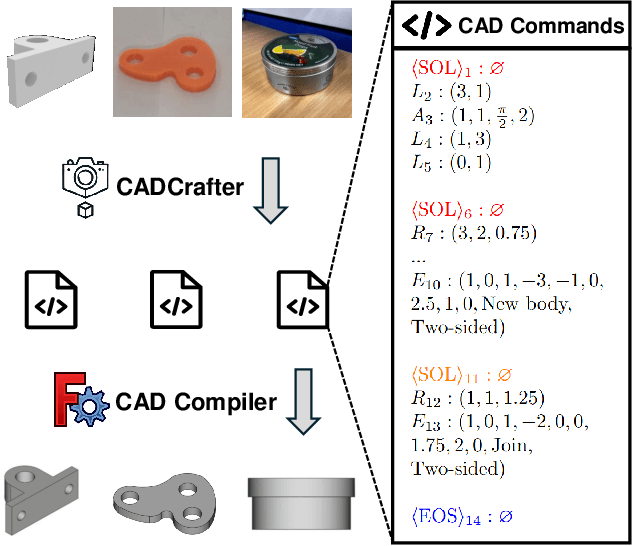
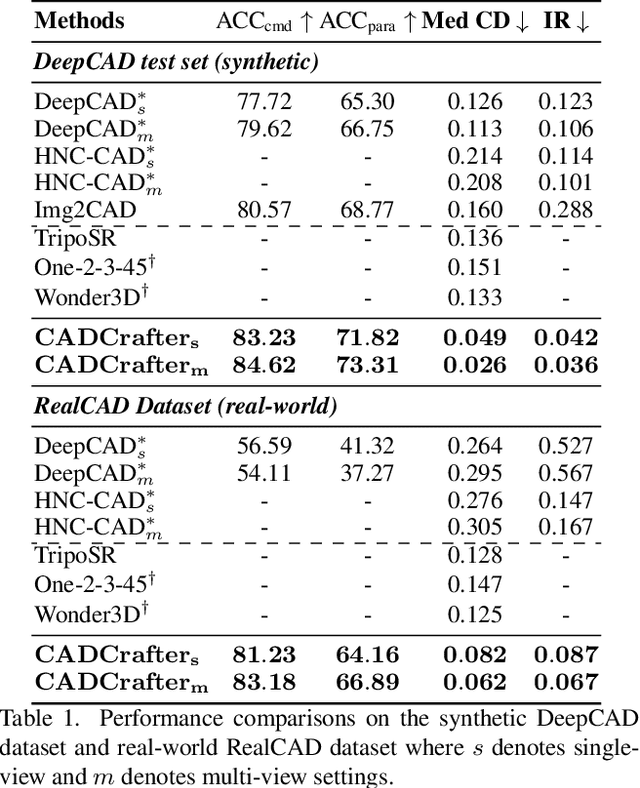
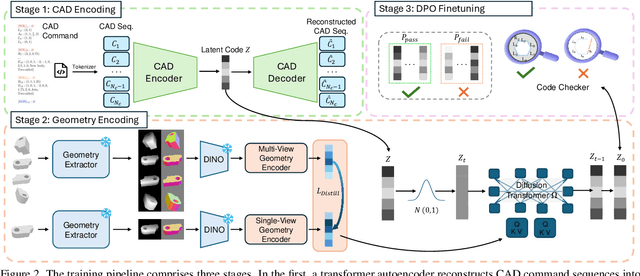
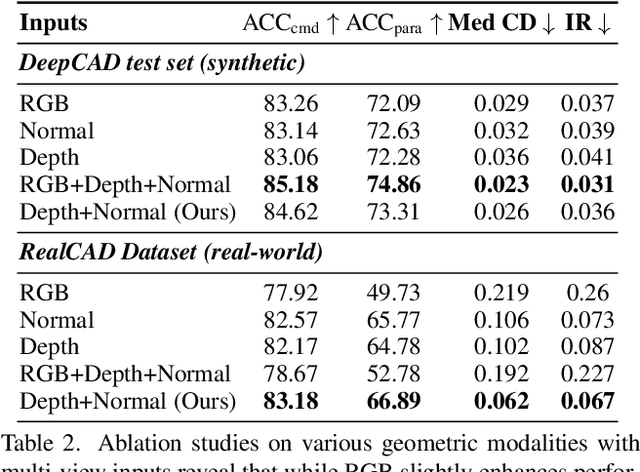
Creating CAD digital twins from the physical world is crucial for manufacturing, design, and simulation. However, current methods typically rely on costly 3D scanning with labor-intensive post-processing. To provide a user-friendly design process, we explore the problem of reverse engineering from unconstrained real-world CAD images that can be easily captured by users of all experiences. However, the scarcity of real-world CAD data poses challenges in directly training such models. To tackle these challenges, we propose CADCrafter, an image-to-parametric CAD model generation framework that trains solely on synthetic textureless CAD data while testing on real-world images. To bridge the significant representation disparity between images and parametric CAD models, we introduce a geometry encoder to accurately capture diverse geometric features. Moreover, the texture-invariant properties of the geometric features can also facilitate the generalization to real-world scenarios. Since compiling CAD parameter sequences into explicit CAD models is a non-differentiable process, the network training inherently lacks explicit geometric supervision. To impose geometric validity constraints, we employ direct preference optimization (DPO) to fine-tune our model with the automatic code checker feedback on CAD sequence quality. Furthermore, we collected a real-world dataset, comprised of multi-view images and corresponding CAD command sequence pairs, to evaluate our method. Experimental results demonstrate that our approach can robustly handle real unconstrained CAD images, and even generalize to unseen general objects.